
“Within the old walls of Hayden Hall lives the memory of its first members, whose dedication and vision shaped the foundation of the institution in its earliest days. These walls stand as silent witnesses to their commitment, hard work, and spirit of service that gave birth to a mission rooted in compassion and community upliftment. Every corner reflects the legacy they began — a legacy that continues to inspire generations and reminds us that the true strength of Hayden Hall was built by the people who first believed in its purpose.”
.png)
History
“Even the old walls breathe hope — reminding us that strength and purpose never fade with time.”
.jpg)
COMMUNITY ENGAGEMENT
BUILDING TRUST THROUGH COMMUNITY DIALOGUE:
Rather than working only through programmes, Prof. C.B. Rai focused on developing genuine relationships with families and local groups. He engaged in open conversations, listened to community concerns, and encouraged people to take part in decision-making for local welfare activities. This approach helped create a sense of mutual trust, where communities felt comfortable engaging in development processes and expressing their real needs.
SUPPORTING VULNERABLE COMMUNITIES:
A key aspect of Prof. C.B. Rai’s work was his consistent focus on individuals and families facing social and economic vulnerability. His field engagement aimed at identifying those most in need and ensuring they were included in welfare support systems. Through this commitment, he reflected the core values of compassion and dignity promoted by Hayden Hall, leaving behind a meaningful contribution to inclusive community development.
T.B ERADICATION
AIM:
To provide mothers and children with all the facilities necessary to cure and prevent tuberculosis, through proper education, chest X-rays, sputum-testing and adequate follow-up of food and medicine by our paramedic teams.
CONTENT:
A weekly clinic; mass chest X-ray screening using an Odelco camera capable of screening approximately 60 persons per hour; therapeutic follow-up through on-the-spot treatment, medicines and injections, daily take-home rations, and weekly health education sessions; along with regular home visits by paramedics to monitor defaulters, identify new cases, and liaise with the local government TB hospital.”
BENEFICIARIES:
Approximately 5,000 individuals have undergone X-ray screening, of whom nearly 500 are receiving the full benefits of the programme. This number continues to grow at an average rate of five new beneficiaries per week.
CRITERIA FOR SELECTION:
Mothers and children enrolled in our programmes, along with their relatives and close contacts living within the same households, as well as school and college students identified through their respective institutions.

INCOME-GENERATING PROGRAMMES
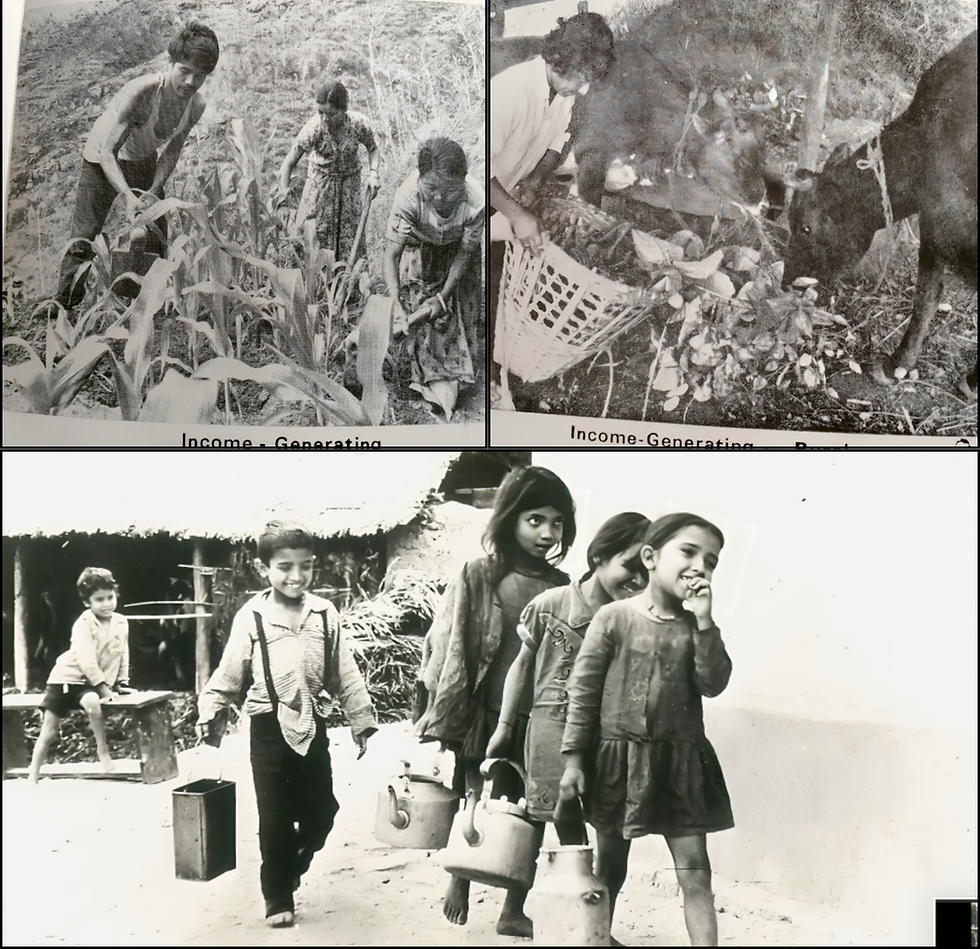
AGRICULTURE AND ANIMAL HUSBANDRY DEVELOPMENT:
Hayden Hall initiated its agriculture and animal husbandry programme in 1974 through cow-purchase loan support, enabling rural families to begin sustainable dairy-based livelihoods. Over time, the initiative expanded to support around 160 families across five villages, who came together to form a cooperative for the collection and supply of milk.
Along with dairy development, training is provided in improved cropping patterns, fodder cultivation, and the use of high-yield seeds and fertilizers. These interventions aim to enhance agricultural productivity, strengthen food security, and increase household income in a sustainable manner.
IN-SERVICE TRAINING AND CAPACITY BUILDING:
A continuous process of in-service training is also conducted for staff and community workers. This includes regular exposure to new ideas and practices in health, communication, community development skills, teaching methodologies, and motivation techniques. Training is also provided to help communities cultivate new types of crops beyond maize and millet, along with improved methods of animal husbandry. As a practical extension of the Nutrition Programme, emphasis is placed on growing vegetables and fruits to improve dietary diversity and household nutrition. Timely education on co-operatives is also given to strengthen collective action and promote sustainable livelihood practices. These trainings collectively help improve field effectiveness and ensure better service delivery to the communities being served.
HOUSING AND SHELTER SUPPORT PROGRAMME
AIM:
Hayden Hall initiated its Housing Programme in 1969 with the aim of rehabilitating victims of landslides and fire incidents while providing safe and dignified shelter to economically disadvantaged families. The programme seeks to support low-income and homeless communities through affordable housing assistance, encouraging stability, security, and improved living conditions.
CONTENT:
The programme began as an emergency response initiative with the construction of 139 homes on government-donated land for displaced families in urban areas. Over time, it developed into a structured housing support system offering interest-free loans to low-income families, enabling them to build homes on their own land.
The initiative also promotes community participation by encouraging beneficiary families to contribute through labour, building materials, or one-third of the total construction cost. These contributions are directed into a Housing Revolving Fund, allowing continued assistance for other families in need and ensuring the long-term sustainability of the programme.
CRITERIA FOR SELECTION:
The programme primarily supports low-income families, homeless individuals, victims of natural disasters such as landslides and fires, and economically weaker communities lacking adequate housing facilities. Priority is given to vulnerable families living in unsafe or unstable conditions, particularly those unable to access formal housing support systems.


FUNCTIONAL LITERACY
AIM:
Hayden Hall initiated its Vocational Training Programme in 1972 with the objective of empowering poor, illiterate, and economically disadvantaged women through income-generating skills. The programme aims to supplement meagre family incomes, promote self-reliance through the marketing of handicrafts, and help bring freedom from hunger, education for children, healthcare support, dignity, and hope to vulnerable families. It also encourages women to organize themselves into local co-operatives for collective economic strength and long-term sustainability.
CONTENT:
The training is conducted throughout the year for varying durations ranging from 3 months to 2 years, depending on the specific skill area such as cotton or woollen weaving. Women are trained to weave a variety of designs using different materials including wool, cotton, and jute on various types of looms. Participants learn to produce marketable handcrafted items such as jholas, handbags, purses, table mats, scarves, belts, stoles, wall hangings, carpets, toys, and other handwoven products.
Upon completion of the training, women are encouraged and supported to work independently or cooperatively in groups, enabling them to establish sustainable livelihoods and improve their standard of living through practical skill-based employment.
CRITERIA FOR SELECTION:
The programme primarily focuses on poor, needy, illiterate, and unskilled women, including widows, mothers, and elder daughters supporting large families. Priority is given to women from economically marginalized communities who have remained largely unaffected by the benefits of mainstream development initiatives.
THE DISABLED
AIM:
Hayden Hall recognizes that poverty and malnutrition remain among the greatest causes of disability, especially among children and vulnerable communities. The programme aims to address the root causes of disability through preventive healthcare, nutritional support, community awareness, and compassionate care, while promoting dignity, inclusion, and equal opportunities for persons with disabilities and marginalized families.
CONTENT:
The initiative emphasizes that prevention is often more effective than cure, particularly in cases where disability is linked to malnutrition, poor maternal health, and lack of basic healthcare. Special attention is given to supporting mothers and children through nutrition programmes, health education, immunization awareness, and community-based care activities designed to reduce preventable disabilities and improve overall well-being.
The programme also encourages communities to respond with greater compassion, responsibility, and social awareness toward those living in poverty, hunger, illness, and disability. Through outreach work, field visits, and community engagement, efforts are made to promote a culture of care, sharing, and human dignity, reflecting the belief that every individual deserves support, respect, and the opportunity to live with hope and security.
CRITERIA FOR SELECTION:
The programme primarily supports malnourished children, persons with disabilities, economically disadvantaged families, vulnerable mothers, and communities affected by poverty, food insecurity, and limited access to healthcare services. Priority is given to individuals and families living in socially and economically marginalized conditions, particularly those requiring nutritional, developmental, and rehabilitative support.

MOTHER AND CHILD HEALTH CARE:
AIM:
To provide poor and needy women from the slums of Darjeeling town and the villages around with full health care through various educational, medical and nutritional inputs.
CONTENT:
This programme consists of once-weekly classes on nutrition and health; an under-five clinic once a month for sick care, growth supervision, and immunisation; a daily dispensary; a weekly maternity clinic for pre and post-natal care and deliveries; a bedward for expectant mothers; a twice-weekly Doctor's clinic; on-the-spot feeding five days a week for 200 malnourished and sick mothers and children; take-home rations weekly of C.R.S. rice, bulgar, blended foods, milk and egg powder; distribution weekly of a 500 gram packet of Premix (a locally blended weaning food of wheat/corn/rice, dal and milk powder) for the under-five child; Paramedic training of rural and urban women who extend the educational and medical care into the homes through their daily house-visits; four Mobile Clinics to provide alternative medical care where it is minimal or non-existent; a Creche for the under-fives of working mothers; a Nutrition Rehabilitation Centre for the severely malnourished and sick child; a centre (Strive) for the mentally and physically handicapped child.
CRITERIA FOR SELECTION:
The programme primarily serves economically disadvantaged mothers, malnourished children, illiterate women, vulnerable families, and socially marginalized communities with limited access to healthcare, nutrition, and educational support. Priority is given to families living in difficult socio-economic conditions, particularly those requiring maternal and child healthcare assistance and developmental support for young children.

ADULT LITERACY:
AIM:
To enable the poor and needy adult illiterates of the rural and urban areas of Darjeeling District to read and write their own mother tongue, Nepali; to help them become more human by making them more fully aware of their community
CONTENT:
The programme consists of 100 centres of 30 students each, covering an area of approximately 933 square miles. These students are taught two hours each day, six days a week, nine to ten months of the year. The Literacy Primer, compiled by our staff, is also used by the government. Every year, our staff trains, at two in-service train-ing camps, not only our own literacy teachers but also the teachers of the government literacy centres, since our's is the only organisation in the Hills with expertise in such training. The students are exposed to instruction in health, nutrition, mother and child care, savings schemes, social evils, co-operatives, farming techniques, accounting etc., through specific follow-up literature. A simple tape-recorder and slides are used to bring this information from the experts to these adult illiterates, most of whom live in remote parts of the Hills. This permits the teacher/supervisor to expose their students to the best available knowledge.
CRITERIA FOR SELECTION:
Adult illiterates from the poor and needy rural and urban communities of the Darjeeling & Kalimpong District.


NUTRITION AND COMMUNITY HEALTH SUPPORT
AIM:
Hayden Hall initiated its Nutrition Programme with the aim of improving the health and nutritional condition of economically disadvantaged mothers and children. The programme seeks to reduce malnutrition, promote healthy eating practices, and create awareness on the importance of balanced nutrition, hygiene, and preventive healthcare within vulnerable communities.
CONTENT:
The programme provides nutritional support through daily feeding initiatives, take-home rations, nutrition rehabilitation activities, and regular health monitoring. Mothers are educated on child nutrition, food preparation, hygiene, and family health through awareness sessions, home visits, and community outreach activities.
As a practical extension of the programme, families are encouraged to cultivate vegetables and fruits to improve household nutrition and food security. Training is also provided on better agricultural practices, fodder cultivation, and improved methods of animal husbandry to strengthen sustainable nutrition and livelihood opportunities within the community.
CRITERIA FOR SELECTION:
The programme primarily focuses on malnourished children, pregnant and lactating mothers, economically weaker families, and communities with limited access to proper nutrition and healthcare services. Priority is given to vulnerable households, particularly those living in rural and socially marginalized areas affected by poverty and food insecurity.


1976
Weaving a Legacy
The launch of our artisanal weaving unit marked an important milestone for Hayden Hall, providing sustainable livelihoods for local women while preserving traditional textile heritage. Guided by the vision of Fr. Edgar Peter Burns, it empowered women through skill development and dignified work, preserving weaving traditions.

1970
Global Impact Recognition
Global Impact Recognition marked an important milestone for Hayden Hall, recognizing its commitment to community development and support for marginalized communities through healthcare, education, and livelihood initiatives, extending its impact beyond the region to a wider global platform.
The Founding Story
Hayden Hall Darjeeling was established in 1969 as a beacon of artisanal excellence and community health. It began with a vision to empower the people of the hills through traditional weaving while providing vital medical care to those in need. What started as an act of faith among founding members has blossomed into a hallmark of sustainable development in the region. Our journey is rooted in the belief that true empowerment comes from honoring our shared heritage while building a future of dignity and holistic growth.


Fr. Burns Starts the Night School
Moved by the sight of young men and women returning from the tea gardens with limited prospects, Father Edgar Peter Burns, SJ realised that literacy was the key to their long-term dignity and empowerment. In 1970, he converted a humble corner of Hayden Hall into a sanctuary for learning after sunset.
By the quiet glow of evening lamps, he personally guided the first students, fostering an environment where education became a tool for self-reliance. This initiative blossomed into the Night School, a cornerstone of Hayden Hall that continues to illuminate the lives of Darjeeling's workforce today.